TRUST & COMPLIANCE

Design for the rules.

Compliance is treated as an engineering input: requirements become controls, workflows, evidence and operational ownership.

CONTROL
SYSTEM
SOC 2Control design and evidence readiness↗
ISO 27001Information security management alignment↗
GDPR / CCPAPrivacy-aware product and data architecture↗
HIPAAHealthcare data and workflow considerations↗
PCI DSSPayment environment security considerations↗
PIPEDACanadian private-sector privacy alignment↗
DPDPIndia privacy and data protection readiness↗

Framework references are capability areas, not claims that BARSPAN or a client is certified. Certification or attestation is determined by the applicable independent assessor.

HOW WE APPROACH COMPLIANCE

Requirements become controls.

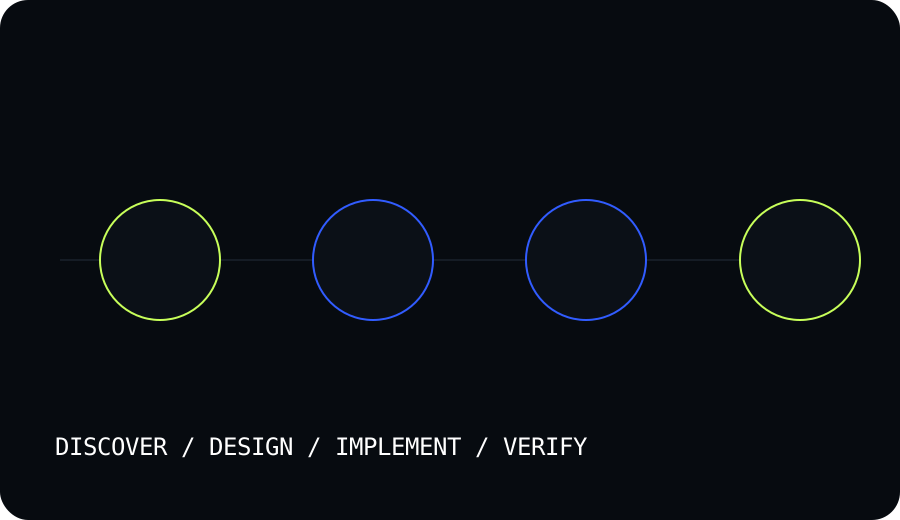
Compliance work fails when it is treated as paperwork bolted onto a finished system. BARSPAN treats each framework as a set of engineering requirements from day one, worked through the same four stages as any other build.

Discover, design, implement, verify compliance methodology
01 / SOC 2

SOC 2

SOC 2 evaluates whether a service organization's controls around security, availability, processing integrity, confidentiality and privacy are designed properly and operating effectively over time. It's the report most B2B and SaaS customers ask for before they'll sign. BARSPAN designs the underlying systems — access control, change management, logging, encryption, vendor management — so the controls an auditor tests actually hold up, and works with your chosen audit firm rather than acting as one.

Example engagements

Building access-control and audit-logging into a platform ahead of a first Type I audit. Automating evidence collection that a team was previously gathering by hand every quarter. Closing control gaps identified in a prior audit before the next assessment window.
Type I & Type II readinessAccess controlsAudit loggingEvidence automation
SOC 2 controls and evidence diagram
  • Where BARSPAN helps
  • Access control & least-privilege architecture
  • Change-management & deployment controls
  • Centralized logging & audit trails
  • Encryption at rest and in transit
  • Vendor & sub-processor risk tracking
  • Automated evidence collection tooling
  • Incident response process design
02 / ISO 27001

ISO 27001

ISO 27001 is an international standard for an information security management system (ISMS) — the ongoing process of identifying risks, applying controls and reviewing them, not a one-time checklist. BARSPAN helps translate the standard's Annex A controls into concrete architecture and operational practice: asset inventories, risk registers, access policies and the technical controls that back them, built to hold up under a certification audit.

Example engagements

Standing up an asset inventory and risk register ahead of certification. Implementing the technical controls an ISMS gap assessment flagged as missing. Building the logging and access-review processes an ongoing ISMS requires.

ISMS architectureRisk registersAnnex A controlsContinuous monitoring
ISO 27001 information security management diagram
  • Where BARSPAN helps
  • Risk assessment & treatment planning support
  • Asset inventory & classification systems
  • Access policy design & enforcement
  • Security monitoring & incident logging
  • Business continuity & backup architecture
  • Supplier security review processes
  • Documentation aligned to Annex A controls
03 / PRIVACY

GDPR / CCPA

GDPR (EU) and CCPA/CPRA (California) give individuals rights over their personal data — to access it, correct it, delete it and know how it's used — and require organizations to justify why they collect it in the first place. BARSPAN builds this into the product itself: data minimization at the schema level, consent capture that's actually enforced downstream, and the deletion and export tooling that turns a privacy request from a manual scramble into a supported workflow.

Example engagements

Building a self-service data-export and deletion flow to satisfy subject-access requests. Redesigning a signup flow so consent capture matches what downstream systems actually do with the data. Mapping and minimizing personal-data fields across a legacy schema.

Data subject rights toolingConsent managementData minimizationRetention automation
GDPR and CCPA privacy and consent diagram
  • Where BARSPAN helps
  • Data mapping & minimization reviews
  • Consent capture & preference management
  • Subject access, export & deletion tooling
  • Data retention & automated purge policies
  • Cross-border data-transfer architecture
  • Privacy-by-design product reviews
  • Breach detection & notification workflows
04 / HEALTHCARE

HIPAA

HIPAA governs how protected health information (PHI) is stored, transmitted and accessed in the US. BARSPAN builds the technical safeguards the Security Rule expects — encryption, access controls, audit logging, session management — into applications that handle PHI, and structures integrations (EHRs, labs, billing systems) so PHI only reaches the systems and people that actually need it, with a clear audit trail of who accessed what and when.

Example engagements

Adding role-based access and audit logging to an application ahead of a business-associate relationship. Building a secure document-exchange flow between a portal and an EHR. Reviewing an existing system's data flows for unnecessary PHI exposure.

Security Rule safeguardsAudit loggingBAA-ready integrationsEncrypted PHI storage
HIPAA protected health information diagram
  • Where BARSPAN helps
  • PHI access control & role-based permissions
  • Encryption of data at rest and in transit
  • Detailed audit logging of PHI access
  • Secure messaging & document exchange
  • Business-associate integration architecture
  • Session timeout & authentication hardening
  • Breach-risk assessment support
05 / PAYMENTS

PCI DSS

PCI DSS governs how systems that store, process or transmit cardholder data are secured. The most effective control is usually architectural — keeping card data out of your environment entirely by routing it through a tokenizing processor — and BARSPAN designs payment flows that minimize PCI scope this way wherever possible, then hardens what remains: network segmentation, encryption and access logging around any system that still touches cardholder data.

Example engagements

Re-architecting a checkout flow to tokenize card data and shrink PCI scope. Segmenting a network so only a small, auditable set of systems touches cardholder data. Reviewing a payment integration ahead of a Self-Assessment Questionnaire.

TokenizationScope reductionNetwork segmentationEncrypted transmission
PCI DSS cardholder data segmentation diagram
  • Where BARSPAN helps
  • Payment tokenization & scope reduction
  • Network segmentation around cardholder data
  • Encrypted transmission & storage design
  • Access logging for in-scope systems
  • Vulnerability scanning & patch processes
  • Secure coding review for payment flows
  • SAQ & scope-documentation support
06 / INDIA

DPDP

India's Digital Personal Data Protection Act (DPDP) sets consent, purpose-limitation and data-fiduciary obligations for organizations handling the personal data of individuals in India. BARSPAN builds the consent-management, purpose-tracking and grievance-handling mechanisms the Act expects into applications and data pipelines that touch Indian user data, so compliance is enforced in the system rather than managed as a manual policy exercise.

Example engagements

Building a consent-management layer that ties data use back to stated purpose. Adding a grievance-handling workflow for data-principal requests. Reviewing a data pipeline for cross-border transfer implications under the Act.

Consent architecturePurpose limitationGrievance workflowsData-fiduciary mapping
India Digital Personal Data Protection Act diagram
  • Where BARSPAN helps
  • Consent capture tied to stated purpose
  • Data-principal request & grievance workflows
  • Purpose limitation enforced in data pipelines
  • Data-fiduciary obligation mapping
  • Retention & deletion automation
  • Cross-border transfer review
  • Breach notification process design
07 / CANADA

PIPEDA

PIPEDA governs how Canadian private-sector organizations collect, use and disclose personal information, built around meaningful consent and accountability for how data is handled once collected. BARSPAN applies the same privacy-by-design architecture used for GDPR and CCPA work — data minimization, clear consent capture, access and correction tooling — adapted to PIPEDA's fair-information-principles framework for organizations operating in or serving Canada.

Example engagements

Reviewing a data-collection flow against PIPEDA's fair information principles. Building access-and-correction request handling for Canadian users. Documenting data-handling accountability for a privacy-impact assessment.

Fair information principlesConsent designAccountability documentationPIA support
Canada PIPEDA private-sector privacy diagram
  • Where BARSPAN helps
  • Fair-information-principles alignment reviews
  • Meaningful-consent capture design
  • Access & correction request tooling
  • Data-handling accountability documentation
  • Cross-border data flow review
  • Breach record-keeping & reporting support
  • Privacy-impact assessment support